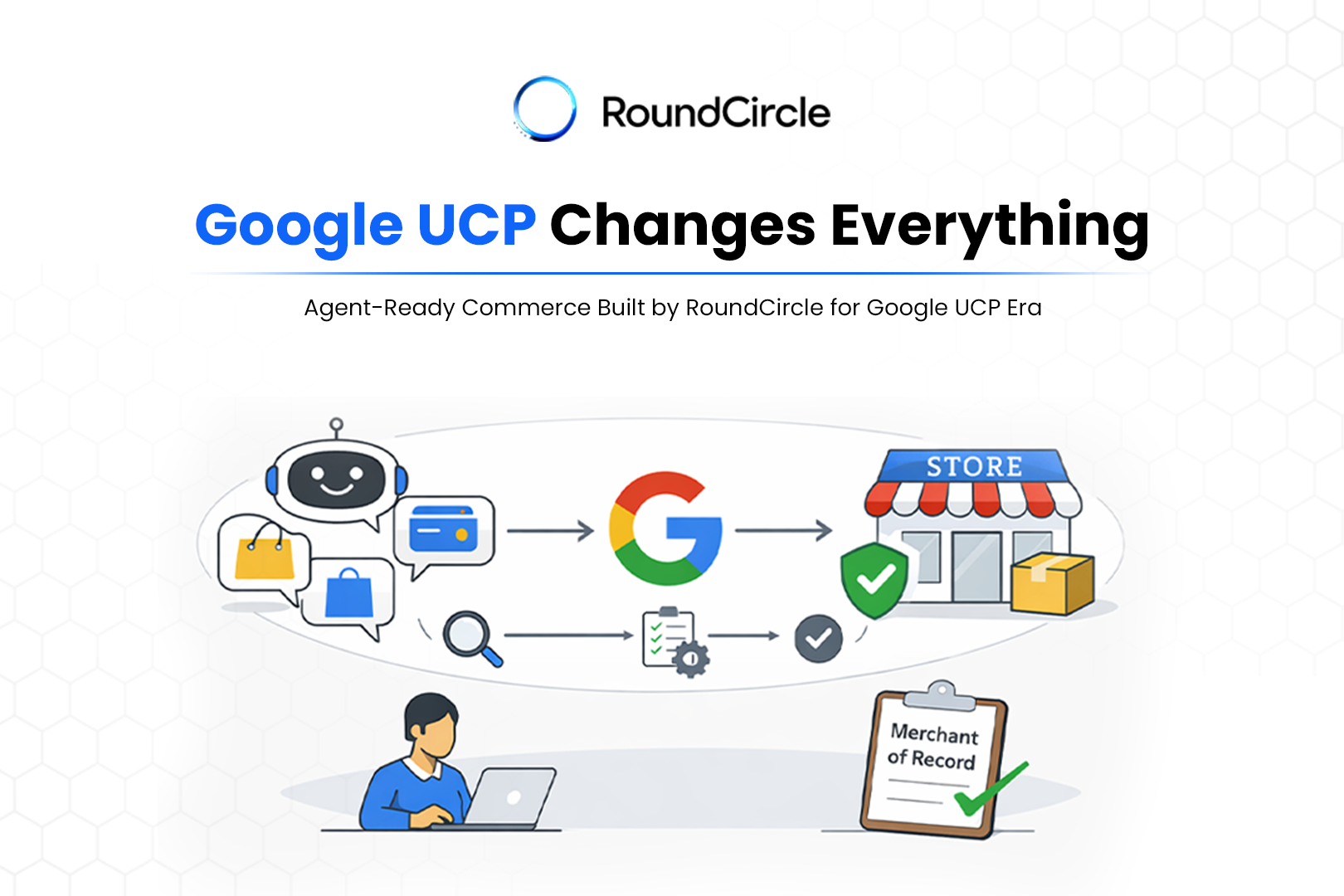
Commerce has always been shaped by interfaces. Catalogs. Websites. Apps. Marketplaces.
At RoundCircle, we work closely with teams building AI-led commerce systems, and one pattern is becoming clear. Commerce is no longer defined by where users click. It is defined by what AI systems can execute.
The Google Universal Commerce Protocol signals this shift clearly. When an AI can discover a product, evaluate fit, negotiate constraints, and complete a transaction within the same interaction, checkout stops being a destination. It becomes an action. Google UCP formalizes this shift by turning buying into something machines can execute rather than simply recommend.
This is not a small change. It is a structural one.
Commerce is No Longer Clicked. It is Executed.
Most digital commerce stacks were built on a simple assumption.
Users browse, compare, click, and convert.
AI breaks that assumption.
In conversational commerce experiences, intent appears before navigation. A user asking an AI assistant for recommendations or guidance is already deep into decision-making. What slows conversion now is not persuasion. It is friction between disconnected systems.
Google Universal Commerce Protocol exists to remove that friction. It allows AI-powered checkout to happen directly inside intelligent interactions, without redirecting users across pages, apps, or sessions.
This is the foundation of agentic commerce.
Why Google Universal Commerce Protocol (UCP) Exists
Google UCP was not created to improve buttons or shorten funnels.
It exists because AI agents cannot operate reliably on interfaces built only for human behavior.
Agents require structured product data, programmatic checkout flows, and predictable outcomes. They need clarity on what a merchant supports, which constraints apply, and how a transaction can be completed securely.
Google Universal Commerce Protocol introduces a standardized way for AI systems to discover commerce capabilities, negotiate terms, and execute transactions. Instead of custom integrations for every platform and payment flow, commerce becomes machine-readable and interoperable through shared commerce protocols.
This is why Google UCP matters beyond search or discovery. It enables execution.
What Makes Google Universal Commerce Protocol (UCP) Different
Many commerce innovations promise speed or convenience. Google UCP changes the operating model.
It is a protocol rather than a platform. Google Universal Commerce Protocol does not replace existing commerce systems. It connects them. Merchants, payment providers, and AI systems communicate through shared standards rather than bespoke integrations.
Brands retain control. Merchants remain the Merchant of Record. They own the customer relationship, transaction data, and post-purchase experience. The AI acts on behalf of the user, not in place of the brand.
Checkout becomes a capability rather than a page. Instead of fixed flows, checkout is expressed as negotiable actions. An AI system determines what it can complete autonomously and where human input is required.
This structure supports collaboration between humans and agents, without blind automation.
From Funnels to Agent-Driven Systems
Traditional funnels assume linear movement. Agentic commerce does not.
In conversational commerce, discovery, evaluation, and purchase collapse into a single execution loop. Instead of optimizing handoffs between stages, brands must support intelligent negotiation between systems.
This shifts priorities.
Success is no longer driven by page-level conversion rates. It depends on whether systems can express rules clearly, respond programmatically, and complete actions without failure.
Google Universal Commerce Protocol accelerates this transition by making commerce executable inside AI interactions rather than dependent on navigation paths.
What Breaks First for Most Brands
Google Universal Commerce Protocol is not difficult to integrate. Readiness is the challenge.
The first cracks usually appear in four areas.
Product Data:
Most catalogs were written for humans and search engines. AI systems require structured, contextual, and comparative information to reason effectively.
Checkout Logic:
Many checkout systems assume browsers, sessions, and manual input. AI-powered checkout requires deterministic APIs and explicit states.
Commerce Rules:
Pricing, fulfillment, loyalty, and compliance rules often live in fragmented systems. Agentic commerce requires these rules to be expressible and negotiable in real time.
Measurement and Observability:
When AI systems initiate transactions, traditional tracking models lose visibility unless instrumentation supports agent-led execution.
Google UCP does not solve these issues. It exposes them.
Native Integration is Easy. Readiness is Not.
Google Universal Commerce Protocol supports both native and embedded checkout approaches. From a technical standpoint, these paths are accessible.
From a systems perspective, they demand discipline.
Protocol compliance alone does not guarantee success. Brands must ensure their commerce systems are modular, expressive, and resilient enough to collaborate with AI systems without losing control or trust.
This is where the difference between implementation and architecture becomes clear.
The Questions Leaders Should be Asking Now
Instead of focusing on rollout timelines, leaders should be asking harder questions.
- Can an AI system understand our catalog without human interpretation?
- Can our checkout logic execute programmatically without failure?
- Can our commerce rules adapt dynamically to context?
- Can we support agent-driven transactions while remaining the Merchant of Record?
These are architecture questions.
Agentic Commerce is an Architecture Decision
Google Universal Commerce Protocol makes one reality clear. The future of commerce will reward execution-ready systems rather than surface-level optimization.
Brands that treat conversational commerce as a UI trend will struggle. Brands that treat Google UCP as a signal to modernize their commerce architecture will compound advantages over time.
Agentic commerce favors teams that can act, not just attract.
From Protocol to Practice
At RoundCircle, we work with teams that want to move beyond experiments and build commerce systems ready for agentic execution. If you are thinking about how Google Universal Commerce Protocol impacts your architecture, data, and checkout systems, we would love to talk.
Get in touch with RoundCircle to explore what agent-ready commerce looks like in practice.