CTOs evaluating conversational commerce often ask the same technical questions. They are not looking for hype. They want clarity on architecture, performance, data handling, and reliability. They want to know whether these systems can scale without breaking existing stacks or creating hidden risk.
This FAQ addresses the most common technical questions CTOs ask when conversational commerce moves from experimentation to production consideration.
What actually powers a conversational commerce system
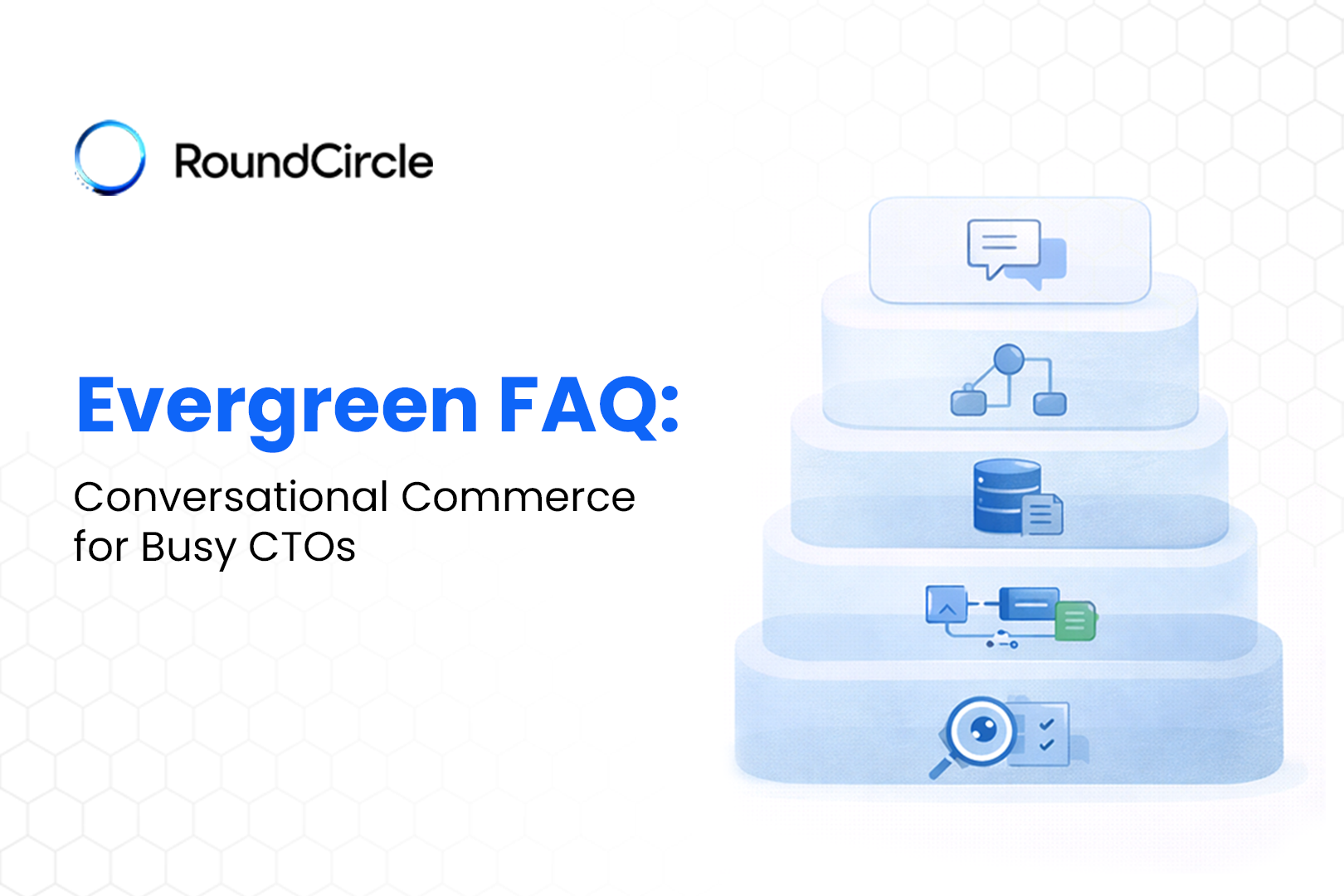
Conversational commerce systems are not single tools. They are composed of multiple layers that work together.
At a high level, a production system includes data sources, retrieval logic, reasoning models, workflows, evaluation frameworks, and observability. The chat interface is only the surface. The real work happens in how the system retrieves information, reasons about it, and completes actions across enterprise tools.
This layered approach allows teams to add intelligence without rewriting their entire stack.
How latency is handled in real deployments
Latency is a top concern for CTOs, especially when conversational systems touch checkout, support, or order management.
In production environments, latency is controlled through:
- caching for frequent queries
- parallel retrieval paths
- lightweight intent classification before deep reasoning
- asynchronous workflows for long running actions
Well designed systems do not route every request through heavy model calls. They balance speed and depth based on intent. This keeps response times predictable and within acceptable limits for customer facing use cases.
How conversational systems integrate with existing stacks
Most CTOs assume conversational commerce requires major rewrites. In practice, integration is incremental.
Conversational systems typically connect to:
- OMS
- CRM
- catalog services
- pricing engines
- logistics tools
- identity systems
Integration happens through APIs and event driven patterns. This allows teams to introduce conversational flows without disrupting core services. The system acts as an orchestration layer rather than a replacement.
What data is required to get started
Teams often worry about data readiness. Conversational commerce does not require perfect data, but it does require structured access.
At minimum, systems need:
- product data
- order data
- policy rules
- workflow endpoints
As usage grows, teams can layer in customer history, preferences, and behavioral signals. The key is progressive enrichment rather than full data overhaul.
How data security and access control are handled
Security and governance matter once conversational systems move into production.
Strong implementations include:
- role based access
- scoped retrieval
- audit logs
- encrypted data flows
- environment isolation
Observability tools play an important role here. They help teams understand which data was accessed, why it was accessed, and how it influenced the response.
Industry guidance from IBM highlights observability as a core requirement for enterprise agent systems, especially when sensitive data is involved.
How observability works for conversational systems
Observability answers questions accuracy cannot.
It shows:
- which tools were called
- what data was retrieved
- how reasoning progressed
- where failures occurred
- why a response stalled or escalated
This visibility helps teams debug issues quickly and maintain trust in automated systems. It also supports governance by making system behavior transparent to engineering and compliance teams.
How evaluation replaces guesswork
CTOs often ask how to know if a conversational system is improving.
Evaluation frameworks measure:
- task completion
- resolution rate
- policy adherence
- reasoning quality
- consistency across turns
These metrics align more closely with customer outcomes than raw model scores. They allow teams to improve reliability without guessing what changed.
How systems scale across regions and languages
Scaling conversational commerce across regions introduces challenges around language, rules, and behavior.
Production systems separate:
- language handling
- business logic
- retrieval
- workflows
This allows teams to add languages or regions without rewriting the core logic. Evaluation and observability ensure consistency across deployments.
What failure looks like and how it is handled
No system is perfect. What matters is how failures are managed.
Well designed conversational systems:
- detect uncertainty
- escalate when needed
- fall back gracefully
- log failure patterns
- surface gaps for improvement
This approach reduces risk and prevents silent failure in customer journeys.
When conversational commerce makes sense technically
Conversational commerce is a good fit when:
- customers ask repeat questions
- workflows are predictable
- data is accessible through APIs
- teams want to reduce friction
- support load is growing
It is less effective when data is inaccessible or workflows are undefined. A technical readiness review helps determine fit early.
How RoundCircle supports technical teams
RoundCircle works with CTOs to design conversational systems that fit existing architectures. This includes:
- integration planning
- data access strategy
- observability setup
- evaluation frameworks
- rollout planning
The focus is on reliability, clarity, and long term maintainability rather than demos that break in production.
Next step for CTOs
If you are evaluating conversational commerce and want technical clarity rather than marketing answers, a focused discussion helps.
Book a 1:1 technical deep dive with RoundCircle to review architecture, observability, and evaluation strategy.