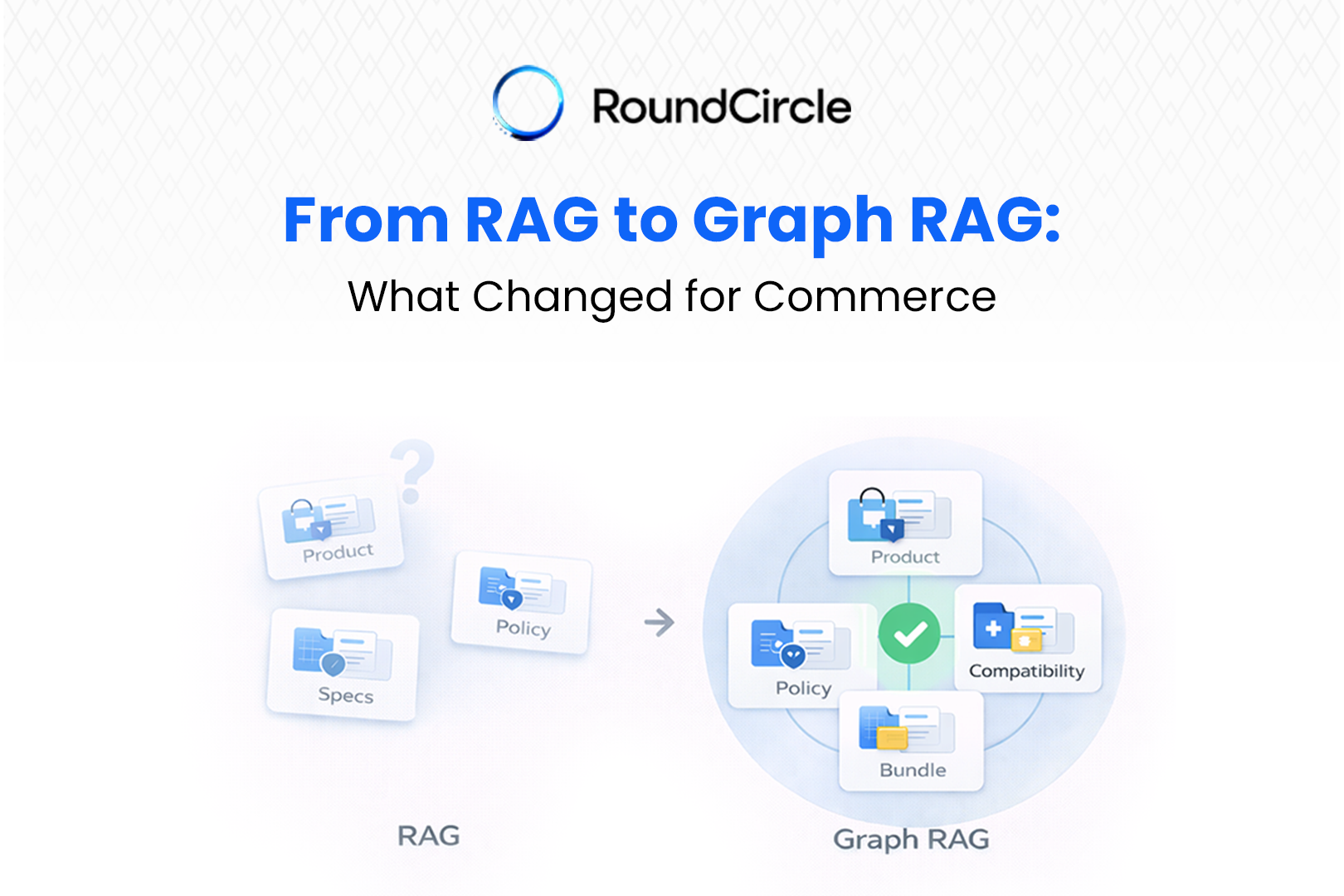
Most teams still treat RAG as the final answer for retrieval problems, but commerce requires something more structured. RAG helps systems pull relevant text, but customers need clarity, not fragments. Commerce catalogs contain relationships that influence every buying moment. These relationships shape compatibility, bundles, recommendations, and policies. RAG cannot interpret these relationships. Graph RAG can.
This shift matters because customers want direct answers that help them make decisions with confidence. Brands want stronger reasoning across product logic. Graph RAG supports both.
Why RAG Became Popular in Commerce
RAG spread quickly because it improved accuracy and reduced hallucination. Teams used it to:
- retrieve product information
- surface policy text
- answer simple questions
- improve factual consistency
RAG made retrieval easier by giving the model access to indexed documents. For early conversational systems, this felt like real progress.
But commerce requires more than retrieval. It requires understanding. Products interact with each other. Rules influence choices. Policies depend on context. RAG does not handle these relationships well because it treats everything as flat text segments.
Teams soon realized that many customer questions do not ask for information but seek guidance rooted in structure.
Products Are Not Flat Text
Commerce catalogs include layered information such as:
- attributes
- variants
- compatibility
- relationships
- bundles
- exclusions
- regional rules
- inventory conditions
RAG sees these as independent pieces. Customers see them as connected. This gap creates unclear responses when customers ask questions that depend on structure.
A simple charger question, a multi item bundle inquiry, or a return policy question often requires logic, not retrieval. Commerce teams need systems that understand product relationships instead of hoping the model interprets text correctly.
The Shift to Graph RAG
Graph RAG improves reasoning by adding structure. Instead of treating product information as isolated text, Graph RAG creates a connected map of relationships. This allows the system to follow the correct logic when answering questions.
Graph RAG supports:
- compatibility reasoning
- bundle validation
- variant comparison
- rule interpretation
- policy clarity
- personalized recommendations
These improvements reduce customer confusion and create more confident purchasing decisions. They also improve agent behavior because decisions come from relationships, not loose phrases.
Industry research from OpenTelemetry and IBM highlights that structured reasoning improves reliability and supports more predictable outcomes across agent systems.
Before and After: Compatibility
Before (RAG)
Customer: “Will this charger work with my older device”
RAG retrieves text mentioning ports and voltage but may combine unrelated content.
This produces answers that sound correct but lack certainty.
After (Graph RAG)
Graph RAG identifies relationships such as:
- supported models
- connector types
- voltage rules
- exceptions
- allowed variants
The response becomes clear.
Customers receive a confident yes or a clear explanation of why not.
This reduces returns and improves conversion because customers trust the answer.
Before and After: Bundles
Before (RAG)
Customer: “Can I buy these products together”
RAG pulls product descriptions but does not check whether the items belong together or match conditions.
After (Graph RAG)
Graph RAG evaluates:
- accessory match
- compatibility rules
- bundle promotions
- regional conditions
- exclusions
The system can approve or decline the bundle with clear reasoning.
Brands benefit from higher upsell success because suggestions follow real logic.
Before and After: Policies
Before (RAG)
Customer: “Can I return this after 14 days”
RAG retrieves policy text but may highlight a rule from the wrong category.
After (Graph RAG)
Graph RAG understands:
- product category
- purchase timing
- exception lists
- refund vs exchange conditions
The customer receives the correct rule without reading paragraphs of policy content.
This improves clarity and reduces misunderstandings across categories.
Why Graph Structure Matters for Commerce
Commerce is built on relationships. Customers need guidance that reflects connections between products, rules, and actions. RAG retrieves information. Graph RAG interprets structure.
This improves:
- product guidance
- comparisons
- recommendations
- bundle suggestions
- policy clarity
- checkout confidence
A structured approach helps brands deliver conversations that feel accurate and trustworthy.
Role of EVALs and Observability When Using Graph RAG
Graph RAG improves reasoning, but teams still need methods to understand how the system behaves. Observability helps leaders view:
- decision paths
- missing relationships
- unclear edges
- failed graph navigation
- inconsistent responses
- logic gaps in journeys
Observability shows what the agent actually did, not just what it said.
EVALs help teams measure:
- correctness
- rule alignment
- reasoning quality
- tone consistency
- multi turn performance
This combination makes Graph RAG reliable in real conversations.
Industry articles from OpenTelemetry and IBM emphasize that reliable agent systems require observability to understand why responses succeeded or failed. Graph RAG adds structure. Observability explains behavior.
How RoundCircle Helps Teams Move From RAG to Graph RAG
RoundCircle helps teams build structured conversational systems by supporting:
- data preparation
- graph construction
- product relationship mapping
- rule modeling
- structured retrieval
- custom models for reasoning
- observability layers
- EVAL frameworks
This helps commerce teams deliver clear answers for compatibility, bundles, policies, and comparisons. Customers receive guidance based on structure, not guesswork.
Next Steps for Commerce Leaders
RAG made conversational systems more factual. Graph RAG makes them more intelligent. Commerce teams that rely on simple retrieval face confusion when customers ask questions that depend on structure. Teams that adopt Graph RAG provide clarity and reduce friction.
To understand how Graph RAG can improve your product reasoning and upsell flows:
Book a demo with RoundCircle to begin your exploration of structured conversational systems.